
EEAT Format Explained: 4 Essential Pillars for Growth
Blog Written By : Akash (Freelance Digital Marketer in Palakkad)
Every marketer eventually asks the same question: what does Google actually consider good content? The closest answer is EEAT. As a Freelance Digital Marketer in Palakkad working with local businesses, I have seen how this framework separates websites that earn trust from those that quietly get ignored. In this guide, you will learn what each letter means, why it matters, and how to apply it step by step, whether you run a personal blog, a company website, or a small local shop.
What Is EEAT?
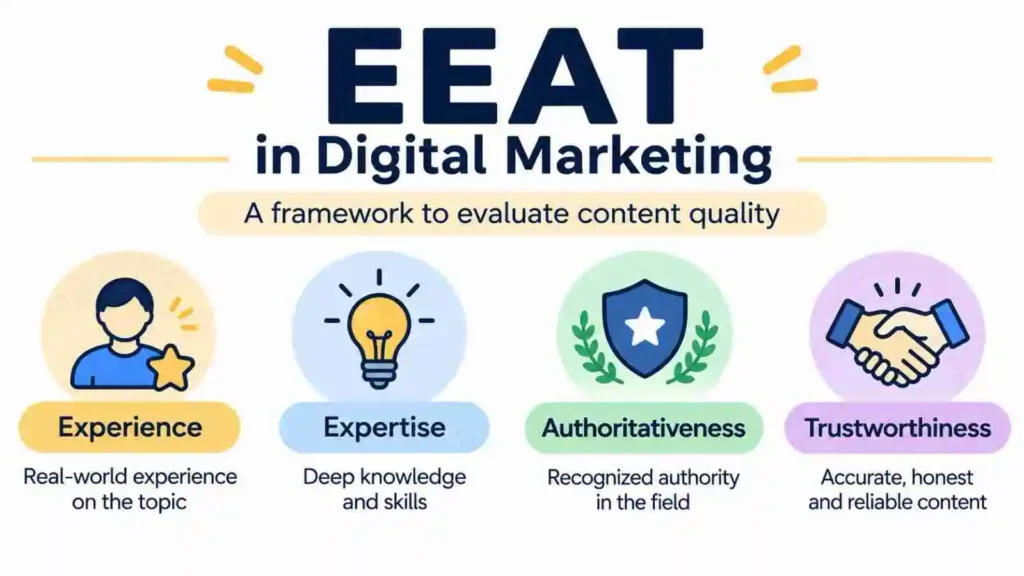
EEAT is the set of qualities that Google’s quality raters look for when judging whether a page is genuinely helpful. Each letter represents a different signal:
Experience: You have personally used, done, or witnessed what you write about.
Expertise: You have the knowledge or skill to explain the topic correctly.
Authoritativeness: Other people in your field recognize you or your brand as a reliable source.
Trustworthiness: Your audience can count on your content to be factual, sincere, and transparent. Google treats this as the foundation that the other three rest on.
Think of it like choosing a doctor. You want someone who has treated patients, studied medicine, is respected by peers, and is honest with you.
Is EEAT a Ranking Factor?
Not directly. There is no single “EEAT score” attached to your website. Instead, Google’s ranking systems are designed to surface helpful, reliable, people-first content, and EEAT describes what that content looks like in practice.
The framework matters most for “Your Money or Your Life” topics, such as health, finance, safety, and legal advice, where poor information can seriously affect someone’s life. Even so, every website benefits from being clearer about who is behind the content and why they can be trusted.
Importance of EEAT for Small Business
Large brands enjoy instant name recognition. Small businesses have to earn trust through visible proof. A clinic, coaching center, shop, or service provider in Palakkad can compete by showing real local experience: genuine customer stories, photos of actual work, a verified Google Business Profile, and clear contact details.
These signals help in two ways. Visitors feel safer contacting you, and search engines gain more confidence that your business is legitimate. When you combine strong EEAT with sound local SEO, you give people a real reason to choose you over a competitor with a larger budget but thinner credibility.
Basic Steps to Build EEAT
- Add a detailed author bio.
- Include your name, photo, role, background, and years of experience.
- Anonymous content rarely feels credible.
- Share first-hand examples. Case studies, screenshots, original photos, and real results show experience that generic articles cannot imitate.
- Cite reliable sources. Link to official documentation, research, and respected publications rather than making unsupported claims.
- Be transparent. Publish an About page, a contact page, and a privacy policy so visitors know exactly who runs the site.
- Secure and polish your site. Use HTTPS, keep pages fast, and make sure everything works smoothly on mobile devices.
- Proofread everything. Spelling errors and broken links quietly weaken trust.
- Intermediate Steps to Strengthen It
Once the basics are in place, these steps help you stand out:
Build topical depth. Rather than publishing random one-off posts, create a cluster of connected articles around a core subject, such as local SEO or email marketing, and link them together.
Earn external mentions. Guest posts, podcast interviews, expert quotes, and industry features build authority far more effectively than self-promotion. Keep content updated. Refresh statistics, remove outdated advice, and display a “last updated” date so readers know the information is current.
Display social proof. Client testimonials, reviews, certifications, and Google ratings reinforce trust at the moment people decide whether to contact you.
Add structured data. Author and organization schema markup helps search engines understand who created your content and how it connects to your brand.
Match search intent. Make sure each page answers what the searcher actually wants, whether they are trying to learn, compare options, or make a purchase.
Maintain a consistent presence. Keep your name, business details, and profile information identical across your website, social media, and directories.
EEAT and AI-Assisted Content
Many marketers now use AI tools to speed up drafting. That is not a problem by itself, but unedited AI text usually lacks the one thing EEAT rewards most: real experience. A machine cannot tell readers about a campaign it ran or a client it helped.
Use AI for outlines and first drafts if you like, then add your own examples, opinions, data, and lessons learned. Review every fact before publishing. The final result should read like it came from a real professional, because it did.
How to Measure Your EEAT Progress
EEAT has no official score, but you can track signs that your credibility is growing:
Enquiries and conversions: The best proof is more calls, form fills, and messages from the right people.Common EEAT Mistakes to Avoid :
Branded searches: More people searching for your name or business suggests growing recognition. Check this in Google Search Console.
Engagement: Longer time on page and lower bounce rates show readers find your content useful.
Reviews and ratings: A steady flow of genuine reviews reflects real customer trust.
Backlinks and mentions: Links from respected sites show others see you as a source worth citing.
- Publishing generic content with no named author
- Making bold claims without evidence
- Copying or lightly rewording content from other websites
- Hiding contact details or business information
- Leaving old, inaccurate posts live
- Chasing keywords while ignoring what the reader needs
- Exaggerating credentials or results
- A Quick EEAT Checklist
Before you hit publish, ask yourself:
Does a real, named person stand behind this post?
Have I included original examples, images, or results?
Are my facts sourced and up to date?
Can readers easily find out who I am and how to reach me?
Does this page fully answer the reader’s question?
Would I be comfortable if a customer fact-checked every claim?
If you can answer yes to most of these, your content is already ahead of much of the competition.
Final Thoughts
EEAT is less a checklist and more a habit: show, don’t just tell, that your content comes from people who know their subject. Whether you are a blogger, an agency, or a freelance digital marketer in Palakkad building a local reputation, consistent proof of real experience will always outlast shortcuts.
Start small. Add your author bio, include one original example in every post, and update one old article this week. Trust is built one page at a time, and both your readers and search engines will notice.
Experience, Expertise, Authoritativeness, and Trustworthiness.
No. It is a quality guideline, but the qualities it describes align with what Google’s ranking systems try to reward.
There is no fixed timeline. Most websites see gradual gains over several months of consistent effort.
No. Small businesses and freelancers can compete by showing real, local, first-hand experience.